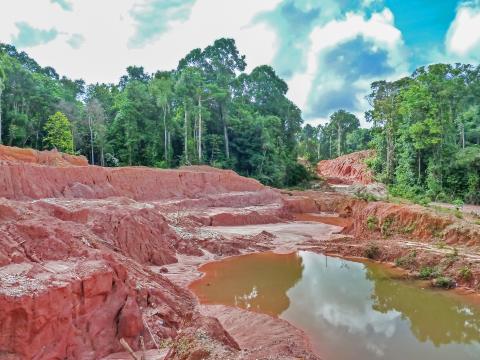
Roads and protected areas in northern Bolivian Amazon (Bolivia : 2005-2007)

Roads and protected areas in northern Bolivian Amazon

New road projects in the Amazon Basin present one of the greatest challenges for accomplishing goals of environmental sustainability and social justice in the region. On the one hand, roads are seen as required elements for economic development, but they can come with a host of social and environmental disadvantages.  These include the destruction of forests and other natural habitats, the loss of biodiversity, the spread of human diseases, displacement of indigenous and non-indigenous communities and the concentration of landholdings. Studies that consider and integrate the varied effects of road projects can point to those investments that best achieve, and, to the extent possible, reconcile economic, environmental and social goals.

read more

Usumacinta Dam (Mexico : 2006-2007)

Usumacinta Dam

In this study we analyze a dam proposed on the Usumacinta River in Mexico. Our objective is to stimulate discussion on the costs and benefits of such projects in the largest watershed in the Maya Forest and in Mesoamerica as a whole. We chose to analyze the Tenosique project (formerly known as Boca del Cerro), given that it is apparently the Usumacinta dam being given the most serious consideration by planners.

read more

Roads in the Selva Maya (Mesoamerica Regional : 2005-2006)

Roads in the Selva Maya

An assortment of road projects has been proposed in the border region of Mexico, Guatemala and Belize, which is part of the Maya Forest, the largest contiguous tropical forest in the Americas north of the Amazon. The proposals are apparently aimed at spurring economic growth and reducing the high levels of poverty found in this area. But more and better roads usually bring more people and expand farms. Decision-makers are therefore confronted with a seeming conflict between conservation and development goals. Would new roads be bad or good for the Maya Forest region?

read more

Roads in the Selva Maya Biosphere Reserve (Guatemala : 2005-2006)

Roads in the Selva Maya Biosphere Reserve

This project consists of environmental valuation, cost-benefit analysis and deforestation modelling of road projects in the Selva Maya Biosphere Reserve, Guatemala.

read more

Changuinola Dams in Panama (Panama : 2005-2006)

Changuinola Dams in Panama

We analyzed four hydroelectric projects planed in Panama’s Bocas del Toro Province. All four projects would be located in the Changuinola-Teribe watershed, within the limits of the Palo Seco Protected Forest (known by the Spanish acronym BPPS). Three of these projects would be built on the Changuinola River, with the fourth on the Bonyic River. Both rivers have their headwaters within the Amistad International Park (PILA). The dams’ combined installed capacity would be 446 megawatts, equivalent to 30 percent of Panama’s total capacity at the end of 2004. Our analysis suggests that the projects would most likely be both economically and financially feasible. Nonetheless, they would cause environmental damage in an area of global conservation interest and impose serious hardship on indigenous communities living along these rivers.

read more

Paraguai-Paraná Waterway (Brazil : 2002-2003)

Paraguai-Paraná Waterway

Considering the potential extension of the Paraguay-Paraná waterway and its social, environmental and economic implications, this study presents an analysis of the influence of the waterway on the logistic structure of Mato Grosso State soybean transportation. Social cost-benefit analyses were carried out for 4 distinct scenarios, and the results indicated feasibility problems, most of them related to environmental externalities and to limitations on load transferring to the waterway route.

read more

Dams and Roads in the Madeira Basin (Amazon Basin : 2006-2006)

Dams and Roads in the Madeira Basin

In this analysis, we assess the effect of Madeira River energy and transportation infrastructure projects on soybean expansion.  Precarious transportation networks and natural barriers have kept the region of the Upper Madeira River geographically and economically isolated and have contributed to the low population densities, particularly in the Bolivian States of Beni and Pando. The development potential of this area, where Brazil, Peru and Bolivia meet, lies in the possibilities of accessing the Atlantic and Pacific Oceans by river or through the construction and pavement of roads.

read more

British Columbia Salmon Aquaculture (Canada : 2004-2005)

British Columbia Salmon Aquaculture

Open net-pen salmon aquaculture is now an established component of the economy in several regions of coastal British Columbia. Despite the prevalence of salmon aquaculture in these regions, the industry continues to come under scrutiny. Environmentalists and conservation biologists worry about the known and potential environmental impacts of net-pen salmon aquaculture; community leaders and development advocates are concerned about the economic sustainability of salmon aquaculture and its impacts on rural economies, especially those economies that traditionally have depended on the harvest of wild salmon.

read more

Belo Monte Dam (Brazil : 2004-2006)

Belo Monte Dam

In this study, we analyze the costs and benefits of the Belo Monte project on the Xingu River in the Southern Amazon. For our analysis, we create three scenarios. The first examines only the “internal” costs and benefits of Belo Monte as an energy project, excluding the costs of its impacts on competing economic activities and the environment. In the second scenario we included some external costs: tourism losses, impacts on water supply and fisheries and declines in water quality during construction. The third scenario also includes these external costs, and estimated energy benefits based on an alternative model, called HydroSim, developed at the Campinas State University (UNICAMP) in São Paulo.

read more

Economic Benefits of Manaus Parks (Brazil : 2003-2004)

Economic Benefits of Manaus Parks

What is the local economic impact of protected areas creation and management?  Most of the time, protected areas are considered barriers to economic development, once they impose limits or even completely block traditional use of natural resources. However, this study demonstrated that 10 protected areas located up to 200 km from Manaus city in the Brazilian Amazon promote important income for local economy. In some situations, these incomes can even surpass earnings generated by traditional land use, demonstrating that conservation activities can have an important role in economic development of certain regions.

read more

Payment for Environmental Services in the Atlantic Rainforest (Brazil : 2005-2006)

Payment for Environmental Services in the Atlantic Rainforest

Financial sustainability of protected areas is always a challenge in developing countries. In this project, CSF developed a methodology to implement a Payment for Environmental Services (PES) system focused on water conservation for human consumption in the Atlantic Forest of Brazil.  This payment system approach is supported by the 47th and 48th articles of the Brazilian National System of Conservation Units Law (which goes by the Portuguese acronym SNUC), which aim to generate income for protected areas management.  The project study area was the Guapiaçu and Macacu rivers basin in Três Picos State Park, close to Rio de Janeiro city.  This basin provides water for about 1.7 million people. 

read more

Monkey Conservation in Bioko (Equatorial Guinea : 2002-2003)

Monkey Conservation in Bioko

Researchers from the National University of Equatorial Guinea (UNGE) and Arcadia University have alerted the international conservation community to the threat of imminent extinction of the seven primate sub-species on the island of Bioko, Equatorial Guinea. These seven species include the drill, red colobus, black colobus, Preuss' guenon, crowned guenon, russeteared guenon and putty-nosed guenon. Similarly, researchers have pointed out the possibility of shortterm disappearance of the island's other large-bodied game animal, Ogilby's duiker.

read more

Economics of a Road Through Madidi National Park (Bolivia : 2005-2006)

Economics of a Road Through Madidi National Park

Rural roads are frequently associated with economic development, but they are often implemented without consideration for their economic feasibility or efficiency. The terms feasibility and efficiency describe investments whose benefits are, at a minimum, greater than their costs. When such criteria are ignored, road projects are funded by governments with no clear expectations of increasing the overall wealth of the country. In fact, they often bring considerable economic losses when accrued benefits do not offset large costs involved with road improvement or construction.

read more

Economic Benefits of Madidi National Park (Bolivia : 2005-2006)

Economic Benefits of Madidi National Park

There is much debate over whether natural protected areas restrict economic development or enable it. In this study we assessed the local economic benefits provided by Madidi National Park & Natural Area of Integrated Management, one of Bolivia’s largest protected areas, and also one of the most important globally for biodiversity conservation.  We applied this analysis approach previously for Amazonian protected areas near Manaus, Brazil.

read more

Infrastructure Integration and Biodiversity Conservation (Mesoamerica Regional : 2004-2006)

Infrastructure Integration and Biodiversity Conservation

This Project consists of gathering information and analyzing infrastructure projects, mainly roads and hydropower plants; in Panamá, Costa Rica, Nicaragua, Honduras, Belice, Guatemala and the nine south east states of México (Campeche, Chiapas, Guerrero, Oaxaca, Puebla, Quintana Roo, Tabasco, Vera Cruz and Yucatán). As part of this project, specific studies on the economic and environmental viability of some infrastructure projects that might be potential threats to biodiversity will be undertaken.

read more

Tanzania National Parks (Tanzania : 2002-2003)

Tanzania National Parks

In 2002, CSF launched the first economic study of Tanzania's national parks. This East African country has some of the most impressive wildlife and landscapes in the world, with famous parks such as Serengeti, Kilimanjaro and Gombe Stream. CSF worked with course graduate Ezekiel Dembe of Tanzania National Parks (TANAPA) and other TANAPA staff to develop a strategy aimed at improving the economic performance of the parks without compromising nature protection. TANAPA's ultimate goal is to increase the profitability of the parks system, which will justify the creation of additional protected areas.

read more

Paracas Reserve (Peru : 2000-2001)

Paracas Reserve

Paracas National Reserve in Peru is home to several species of sea lions, otters, vast anchovetta schools, blue-footed boobies, Inca terns, pink flamingos, pelicans, dolphins and large stocks of scallops. The large reserve has been bolstered in recent years by a volunteer park ranger program, which brings in students to maintain the protected area, clean the beaches and provide outreach to nearby communities. Despite its many contributions, funding for this program is constantly in doubt. Course graduate Cecilia Rivas, of the Peruvian Grupo de Estudios Ambientales (GEA), used skills she learned from CSF to perform a cost-benefit analysis and quantitatively show that the $8000 annual investment in the volunteers produces more than $32,000 in benefits. The benefits are a combination of services to the protected area and education for the volunteers.

read more

Amarakaeri Indigenous Reserve (Peru : 2000-2001)

Amarakaeri Indigenous Reserve

Working with another graduate of our training program, Peruvian biologist Carmela Landeo, CSF is helping examine the real economic impact of roads and logging on Amazonian indigenous communities. Landeo, who works with the Peru office of World Wildlife Fund, is studying changes wrought in the forest and in household incomes as industrial timber extraction draws indigenous villages toward the cash economy. Landeo is studying the communities of Shintuya and Shipeteari, both on the fringes of the Manu National Park.

read more

Roads in Volcán Baru Park (Panama : 2002-2003)

Roads in Volcán Baru Park

Three road investments have been proposed in the vicinity of the Barú Volcano National Park in the province of Chiriquí: (1) a one-lane road from Cerro Punta to Boquete, via the Park; (2) the so-called “southern route” from Cuesta de Piedra to Boquete via Palmira; and (3) paving the access roads as far as the guard stations at the Park’s Eastern and Western entrances (see figure 2). This paper provides an economic analysis of the proposals, conducted by Conservation Strategy Fund (CSF) and The Nature Conservancy (TNC) between February and April, 2003. We employed the “Roads Economic Decision Model,” developed by the World Bank in 1999. The research was jointly funded by the Nature Conservancy and Conservation International (CI).

read more

Canal Project (Panama : 2000-2002)

Canal Project

 CSF is assisting the Centro de Asistencia Legal Popular (CEALP) in analyzing new dams proposed to provide water needed to expand the Panama Canal. After participating in a CSF training, CEALP lawyer Erya Harbar proposed to undertake a legal and economic analysis of dams that would effect both natural ecosystems and campesino communities. The study aims to determine the economic efficiency and equity of the proposed $8 billion expansion of the Panama Canal, including new reservoirs to supply water and electricity. Expanding the canal would require three new dams, aqueducts, transmission lines and roads in a remote 500,000-acre area of forest and small towns. The goal of our work with CEALP has been to inform affected rural communities of their rights and force consideration of the financial and environmental tradeoffs of the bigger canal into the national policy debate on the issue.

read more

Amazon Forest Fires (Brazil : 2002-2002)

Amazon Forest Fires

CSF worked with Brazil 2000 course participant, Ricardo de Assis Mello, a researcher with IPAM (Amazon Environmental Research Institute), to conduct a cost-benefit analysis of alternative agricultural methods aimed at preventing destructive forest fires.

read more

Pantanal Scenic Parkway (Brazil : 2001-2002)

Pantanal Scenic Parkway

The Pantanal in southwest Brazil is the world's largest continuous wetland, extending for at least 140,000 km2 and host to a spectacular array of flora and fauna with over 650 species of birds and 80 species of mammals including parrots, toucans, jaguar, maned wolf, giant otter, and capybara. CSF is helping former course participants Leonardo Hasenclever, now with the United Nations Development Program's unit on Pantanal fisheries, and Eduardo Garcia, of the Wildlife and Environmental Education Research Society (Paraná), conduct a contingent valuation study of tourism on the Pantanal Scenic Parkway to determine its potential for generating revenue for conservation. Ninety-nine percent of the Pantanal is privately owned, mostly by large cattle ranches, and in recent years the Pantanal has come under increased threat from deforestation, upland contamination, poaching, overfishing, and uncontrolled tourism.

read more

Jalapão Water Diversion (Brazil : 2001-2002)

Jalapão Water Diversion

Three Brazil 2000 course participants not previously acquainted are now working together to analyze potential impacts of water diversion from the Tocantins River in central Brazil. The project would divert water from the Tocantins in the Jalapáo region, a unique transition zone between Cerrado woodland and caatinga. The water would be pumped into Brazil's arid Northeast for irrigation and hydroelectric power. Fani Mamede, formerly of IBAMA, Brazil's environmental agency, Paulo Garcia, a conservationist working with the municipality of Mateiros and Wilson Cabral, an engineer at the Sáo Paulo-based Technology and Aeronautics Institute, are performing an analysis of the projects potentially extensive environmental and economic impacts.

read more

Abrolhos Marine Reserve (Brazil : 2000-2001)

Abrolhos Marine Reserve

Abrolhos literally means "eye opener". The Abrolhos reef in Brazil won its name because of its unique coral formations and because its shallow waters are frequented by large numbers of reproducing humpback whales. The peculiar mushroom-shaped coral heads there are composed mostly of species completely unique to Abrolhos. The high degree of species endemism is a result of Abrolhos' total isolation from other coral reefs.

read more

Beni River Watershed (Bolivia : 1999)

Beni River Watershed

The region of Northwest Bolivia where the Andes meet the Amazon plain is alternately considered a rich natural treasure and an under-developed green void. In 1995, the Bolivian government officially protected 1.8 million hectares of rain forest, cloud forest, rare deciduous forest and an array of plant and animal species nearly unsurpassed in the world's nature reserves.

read more

Chalillo Dam (Belize : 1999-2002)

Chalillo Dam

In 2000 CSF worked with the Belize Alliance of Conservation Non-Government Organizations to provide Belizeans with an independent analysis of a proposed dam on the Macal River. The upper Macal and its tributaries provide habitat for rare scarlet macaws, Morelet's crocodiles, river otters, tapirs and jaguars. But it also has potential to supply electricity to consumers throughout Belize.

read more