Diary of an Alumnus: Anita Escobedo

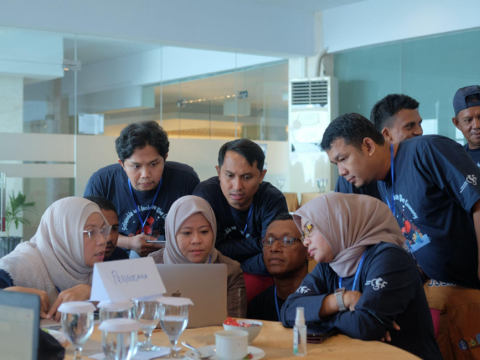
I am pleased to write an update on the activities and conservation initiatives that I have been working on after attending Conservation Strategy Fund’s 2012 course, Economic Tools for Conservation, in Stanford, CA.

Notes from the Field: Economic analysis in the Western Pacific

February was a month of non-stop travel for me. Having just started working with CSF I got shipped off on a whirlwind tour of Micronesia and Bali. Not a bad start I suppose!

Young Mountain Gorilla in the forest with family behind him or her

Outils Économiques pour la Conservation et la Planification d’Infrastructures dans le Rift Albertin

Conservation Strategy Fund accepte dès à présent les demandes d'inscription pour le cours d’Outils Économiques pour la Conservation et la Planification d’Infrastructures dans le Rift Albertin, du 17 au 28 juin 2013 en RDC. Ce cours est offert en partenariat avec L'École Régionale post-universitaire d'Aménagement et de gestion Intégrés des Forêts et territoires Tropicaux (ERAIFT) et est rendu possible grâce aux soutiens de l´USAID (United States Agency for International Development), Wildlife Conservation Network, et l´Handsel Foundation. Nous acceptons les inscriptions de personnes travaillant en Ouganda, au Rwanda, au Kenya, en Tanzanie et en République Démocratique du Congo.

Economic Tools for Conservation - 2012 International Course

Conservation Strategy Fund is now accepting applications for our 14th annual international training course, Economic Tools for Conservation, from August 20-31, 2012 at Stanford University. This course is offered in partnership with the Woods Institute for the Environment and the Center for Conservation Biology at Stanford.

Over the last decade, this course has become recognized as the premier applied economics training event for conservation professionals from around the world.

Click here to view the 2012 course schedule

Incentivos económicos para la conservación: Un marco conceptual

Esta publicación ha sido posible gracias a la Iniciativa para la Conservación en la Amazonía Andina (ICAA) de USAID.

Para obtener más información acerca de ICAA, haga clic aquí.

Para ver la publicación original en la página web de ICAA, haga clic aquí.

-------

This publication was made possible thanks to the USAID Initiative for Conservation in the Andean Amazon (ICAA).

To learn more about ICAA, click here.

To view the original publication on ICAA's website, click here.

Smart Conservation: CSF's Economic Tools Training Program

Conservation Strategy Fund has been training conservationists, natural resource managers, and policy-makers in the language of economics for nearly 15 years. Hear first-hand what our course participants and instructors have to say about why CSF's training programs are effective and make a big difference for conservation.

CSF Launches HydroCalculator Tool Version 3.0

CSF recently released the HydroCalculator Version 3.0 with two major advances. First, the tool interactively enables the user to pinpoint the exact location of the hydro project on a map, which can show satellite imagery and terrain. Second, a global map of land-cover types, with corresponding carbon densities, has been linked to the tool so that it automatically calculates net carbon emissions. Advanced users can override the land-cover selection and choose up to four different types of land-covers flooded by the dam, and their respective shares of the area inundated. We have added dozens of land-cover types – all of those included in the Carbon Dioxide Information Analysis Center dataset.

CSF launches new capacity building program

Knowledge of economic tools in conservation shouldn't just exist on an individual level. In order to make an even bigger impact on nature, CSF is taking its training to the institutional level this month with Wildlife Conservation Society (WCS) in Bolivia. WCS was selected by CSF for our first ever In-House Training, funded by the Gordon and Betty Moore Foundation's Andes-Amazon Initiative (AAI). WCS saves wildlife and wild places worldwide through science, global conservation, education and the management of the world's largest system of urban wildlife parks.

Sustainable economic development in Yap

CSF is helping Yap State in the Federated States of Micronesia design a framework for sustainable economic development. Key stakeholders will explore scenarios for future development, learn how to measure environmental, social, cultural and economic impacts of different types of programs, and evaluate the potential of proposed projects to achieve sustainable development. This effort is one of several analysis projects being conducted in Micronesia following CSF's Economic Tools for Conservation in Micronesia course held in March of 2012.

Economic Tools for Conservation - 2013 International Course

  • Ferramentas Econômicas
  • Segunda, 12 Agosto, 2013 - Sexta, 23 Agosto, 2013
  • Begins in 11 semanas 4 dias

Conservation Strategy Fund is offering its 15th annual international training course, Economic Tools for Conservation, on August 12-23, 2013 located at Stanford University. This course is being offered in partnership with the Stanford Woods Institute for the Environment and the Center for Conservation Biology at Stanford.

Over the last decade, this course has become recognized as the premier applied economics training event for conservation professionals from around the world.

Click here to apply

Divulgar conteúdo